Leak Detection in Inwood, Manhattan
Unexplained ceiling discoloration, bubbling plaster, or water sounds behind bathroom walls require prompt, non-destructive investigation. In Inwood’s classic pre-war buildings and modern multi-unit residences, water can travel along structural floor joists and shared utility chases far from its true origin. We pinpoint concealed pipe leaks accurately before unnecessary demolition begins.
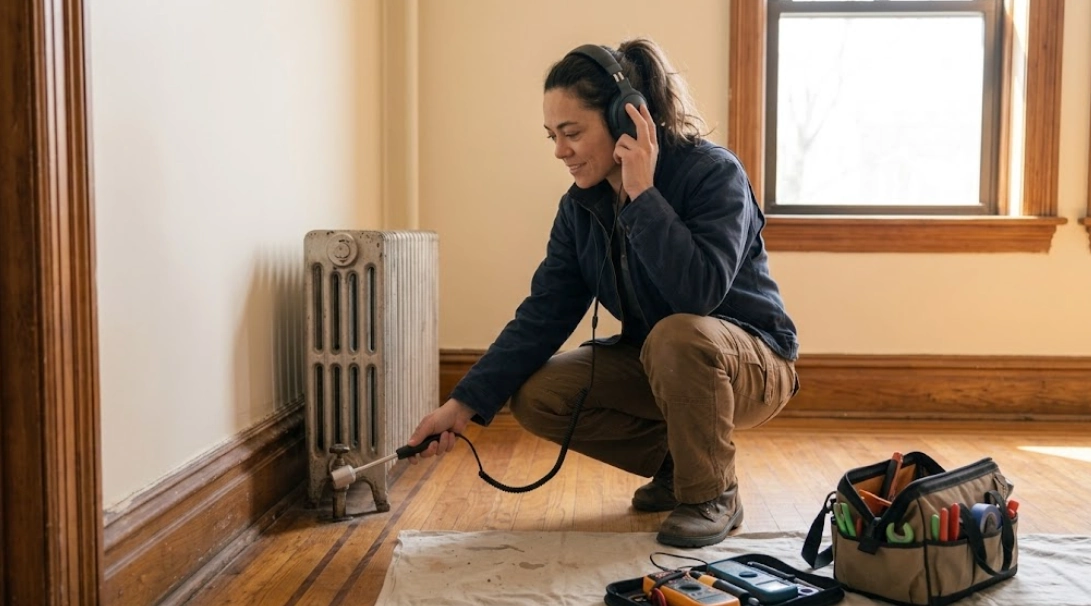
Warning Signs of a Concealed Plumbing Leak
Concealed plumbing leaks rarely show themselves directly at first. Instead, moisture slowly accumulates inside masonry wall cavities, beneath hardwood parquet flooring, or above plaster ceilings until visible cosmetic or structural symptoms appear. Recognizing early warning signs helps property owners, co-op boards, and tenants request an evaluation before substantial water damage occurs.
Ceiling Stains & Bulging
Yellow or brown water rings spreading across plaster or sheetrock ceilings indicate active moisture accumulation from an upstairs branch line or communal riser.
Bubbling Paint & Soft Drywall
When water escapes within a partition cavity, wall surfaces blister, paint peels, and drywall becomes spongy to the touch, pointing to an active pipe leak.
Persistent Musty Odors
Trapped moisture within wall shafts promotes mildew growth. A damp, earthy smell in bathrooms or hallways often indicates a hidden, continuous water leak.
Hissing or Drips in Walls
Faint hissing, trickling, or continuous ticking sounds behind walls when all apartment fixtures are shut off indicate pressurized pipe escape requiring acoustic tracing.
Unexplained Water Bills
A sharp or gradual rise in metered water consumption without increased household usage indicates water escaping continuously from a hidden line or faulty valve.
Damp Floorboards
Warped hardwood, cupping planks, or damp baseboards along common walls suggest subfloor water migration from an adjacent unit or branch line.
These symptoms can arise from pressurized domestic supply lines, sanitary drainage stacks, or steam radiator piping. Because visible water stains may develop many feet away from the actual pipe compromise, specialized non-invasive diagnostic tools are essential to locate the true origin.
Why Specialized Leak Detection Matters in Inwood
Inwood is situated at the northern tip of Manhattan, defined by a rich architectural fabric ranging from early 20th-century pre-war apartment buildings and Art Deco co-operatives to mid-century multi-family residences. Neighborhood avenues near Dyckman Street and Broadway, bordering the greenery of Inwood Hill Park, feature multi-story residential buildings that rely on intricate, shared vertical plumbing infrastructures.
In pre-war Inwood properties, plumbing systems commonly incorporate heavy cast-iron soil stacks, vintage galvanized iron domestic water risers, and dual-pipe steam heating systems. Over decades of operation, interior pipe walls experience mineral scaling, galvanic corrosion, and joint fatigue. When a localized leak develops, concrete slab construction and dense masonry fireproofing cause escaping water to travel laterally along steel beams or electric conduits before dripping through a lower ceiling.
Attempting to find leaks by tearing open plaster walls without prior diagnostic testing frequently results in unnecessary structural disruption and elevated restoration expenses. Precision non-destructive hidden water leak detection Inwood Manhattan property owners rely on pinpoints the exact pipe coordinates, minimizing property disruption and expediting repairs.
Need Clear Answers on a Suspected Leak?
If you notice damp drywall, ceiling staining, or water migration in your Inwood apartment or multi-family building, speak directly with a local plumbing diagnostic specialist.
Call (315) 202-8009Common Leak Situations We Investigate
Plumbing diagnostics in multi-story residences encompass several distinct piping systems. Our investigative process addresses the most challenging residential moisture challenges:
Concealed Wall Cavity Leaks
Pressurized hot and cold domestic supply pipes run through vertical chases and horizontal partition cavities. A hairline joint failure or pinhole perforation can spray a fine mist continuously. Through advanced leak in wall detection Inwood Manhattan technicians utilize acoustic listening discs to isolate water vibrations within enclosed cavities.
Ceiling Leaks and Inter-Floor Moisture
When moisture discolors an apartment ceiling, identifying whether the issue stems from an upstairs bathroom trap, shower pan, or an embedded branch riser requires structured testing. We evaluate ceiling patterns to perform targeted ceiling leak repair Inwood Manhattan diagnostics without destructive ceiling removal.
Apartment-to-Apartment Water Migration
Resolving a water leak from upstairs apartment Inwood Manhattan often requires coordination between tenants, building superintendents, and managing agents. Our comprehensive documentation helps clarify whether the moisture originates from a private tenant fixture or a common building riser line.
Shared Plumbing Risers & Aging Stacks
Multi-unit buildings depend on communal vertical shafts. In older properties, corroded galvanized lines can fail behind communal hallways. Where recurring riser failures occur, building owners often evaluate comprehensive repiping services to replace antiquated piping networks.
Mechanical & Heating Equipment Leaks
Heating equipment and domestic boilers can develop pressure-relief leaks, circulator seal failures, or heat exchanger cracks. For dedicated heating inspections, our team provides diagnostic support for boiler repair and water heater repair.
How a Professional Leak Detection Visit Works
A methodical, structured inspection ensures that plumbing anomalies are identified accurately without premature demolition. Here is what happens during a diagnostic evaluation:
- Initial Symptom Review & Timeline: We begin by examining the history of the moisture. Understanding whether the water is constant or intermittent (such as after a shower or dishwasher cycle) provides immediate clues regarding supply versus drainage origin.
- Visual & Fixture Inspection: All accessible fixtures, supply valves, P-traps, toilet seals, and mechanical valves in the affected area and adjoining rooms are examined for visible weeping or condensation.
- Thermal Infrared Imaging: High-resolution thermography scans inspect temperature differences across plaster, drywall, and tiled surfaces. Water escaping from a domestic line alters the surface thermal signature, revealing the moisture path behind walls.
- Acoustic Sound Tracing: Sensitive acoustic listening amplifiers detect the faint sound frequencies produced by water escaping pressurized pipes under wall and floor coverings.
- Moisture Mapping: Calibrated non-invasive moisture meters measure relative moisture depth, confirming the boundary of dampness within structural materials.
- Findings & Clear Action Plan: We review our findings with the property owner, superintendent, or managing agent, outlining the exact source location and recommending targeted repair procedures.
While non-destructive tools drastically reduce structural damage, limited localized access (such as a small exploratory cut) may be required once the exact pipe coordinate is isolated so that a plumber can execute the mechanical repair.
What to Do When You First Discover an Active Leak
Taking prompt, cautious measures upon discovering an active water leak can protect historic flooring, prevent plaster ceiling collapse, and minimize multi-apartment damage:
- Isolate the Water Supply if Safe: If water is actively pouring or spraying from an accessible valve or fixture, turn the local chrome shutoff valve clockwise until water flow ceases.
- Avoid Electrical Hazards: If water is dripping near ceiling lighting fixtures, electrical outlets, or breaker panels, keep clear of the water and shut off electricity to that specific circuit from your service panel.
- Notify Building Management: In multi-family co-ops, condominiums, and rental buildings, alert the resident superintendent immediately. Building staff can access main line valves or coordinate access to neighboring apartments.
- Contain Dripping Water: Place buckets or plastic bins beneath drips, and use clean towels to protect parquet or hardwood floors from soaking up moisture.
- Document Visible Damage: Take clear photographs or video of the active drip and water staining for building management records and insurance documentation.
Suspected Natural Gas Odor Warning
If your leak concerns involve gas piping or you detect a rotten-egg natural gas odor, evacuate the building immediately. Do not use light switches, phones, or doorbells. Once safely outside, call 911 or Con Edison (1-800-75-CONED). Do not use this website or phone line for emergency gas reports.
Comprehensive Plumbing Diagnostic & Repair Services
Beyond precision leak detection, we provide full technical support for Manhattan residential plumbing systems.
Pipe Leak Repair
Targeted repairs for pinhole copper leaks, cracked joints, burst lines, and corroded galvanized pipes inside walls and ceilings.
Learn About Pipe Leak Repair →Repiping
Replacing old, deteriorating galvanized pipes and corroded supply lines with modern, code-compliant copper risers and branch piping.
Learn About Repiping →Water Heater Repair
Diagnosing no-hot-water issues, pilot problems, faulty heating elements, and tank weeping for gas, electric, and indirect water heaters.
Learn About Water Heater Repair →Boiler Repair
Diagnostic troubleshooting for steam and hydronic residential boilers, pressure relief valves, low-water cutoffs, and no-heat calls.
Learn About Boiler Repair →Gas Line Repair & Inspection
Gas line testing, appliance connections, piping repair planning, and NYC Local Law 152 periodic inspection guidance.
Learn About Gas Line Services →Drain Cleaning
Clearing stubborn kitchen sink clogs, bathroom blockages, scale accumulation in cast-iron stacks, and main sewer line obstructions.
Learn About Drain Cleaning →Backflow Testing
Annual backflow assembly inspection, NYC DEP test report filing, repair assessments, and cross-connection containment protection.
Learn About Backflow Testing →Local Service Coverage in Upper Manhattan
In addition to serving Inwood residential properties, our diagnostic specialists assist property managers, landlords, and homeowners across neighboring Upper Manhattan communities. We provide dedicated leak detection near Marble Hill, as well as service across Washington Heights, Riverdale, and Kingsbridge.
Whether your property is an Art Deco co-op on Park Terrace, a classic apartment building along Broadway, or a walk-up near Dyckman Street, our team brings specialized diagnostic equipment tailored to the unique plumbing architecture of Northern Manhattan.
Frequently Asked Questions
Common questions regarding water leak detection in Inwood apartments and residences.
How can a hidden water leak be located behind an apartment wall?
Hidden water leaks are traced using non-invasive diagnostic tools. We employ infrared thermal cameras to detect temperature anomalies caused by moisture, sensitive acoustic equipment to amplify the sound of water escaping under pressure, and calibrated moisture meters to map moisture boundaries without unnecessary wall tearing.
Can a plumbing leak be found without opening every wall?
Yes. Non-invasive leak detection isolates the specific section of pipe before physical work begins. While a small opening may be necessary to complete the mechanical repair once the leak is pinpointed, precision detection prevents widespread damage across multiple rooms.
What should I do if water is coming through my ceiling?
Contain standing water using buckets and towels to protect flooring, move electrical items away from the drip, and immediately inform your building superintendent and upstairs neighbor. Moisture coming through a ceiling typically originates from a fixture, shower pan, or riser on the floor above.
Can a leak in my apartment originate from another unit?
Yes. In multi-family Inwood buildings, water regularly travels along concrete slabs, structural steel, or vertical pipe chases before emerging. Our diagnostic evaluation helps establish whether the moisture stems from your branch line or a neighboring apartment’s plumbing.
When should I arrange a professional leak inspection?
Arrange an inspection immediately if you see unexplained paint bubbling, ceiling discoloration, damp floorboards, or hear water running inside walls when no fixtures are active. Early detection stops hidden decay and structural damage before it worsens.
Speak Directly With a Local Plumbing Specialist
Have questions about an unexplained water stain, damp drywall, or suspicious water sounds in your Inwood building? Call us directly to discuss what you are observing and schedule a diagnostic evaluation.
When you call, let us know the affected rooms, when the moisture first appeared, whether the drip is constant, and if your building has an accessible shutoff valve. We provide clear, practical diagnostic guidance.